

Asking for—and Using—Professional References
A great résumé and a strong interview can get you close to a job offer, but references are often what seals it. Employers use them to confirm that what you said about yourself lines up with how you actually show up at work. Yet most job seekers put far less thought into their references than into anything else in their job search - who to ask, how to ask, what to give them, and how to keep the relationship strong long after the reference call is over. This guide walks through all of it, from building your list to saying thank you once the job is yours.

What is a professional reference, and why do employers request one?
A professional reference is someone who can speak directly to your work, your skills, and your character based on firsthand experience working alongside you. Employers request references because a résumé and interview only show them what you say about yourself - a reference gives them an outside perspective on whether that matches reality. It's one of the last checks in the hiring process, often used to confirm a decision an employer has already leaned toward making, rather than to decide between candidates from scratch.
Who makes a strong professional reference, and how many should you prepare for a job search?
The strongest references are people who worked closely enough with you to speak to specifics - your actual performance, how you handled challenges, and what it was like to work with you day to day. A former supervisor who watched you grow into a role, or a colleague who partnered with you on a major project, usually carries more weight than someone who only knew you casually. What matters most is that they can speak with detail and genuine credibility, not just enthusiasm.
Most job seekers should prepare three to four references for a typical search. That gives enough variety to match different references to different job applications - for example, choosing a supervisor reference for one role and a colleague or client reference for another, depending on which relationship best supports what that particular employer wants to know.
Can a former supervisor, colleague, teacher, mentor, or volunteer coordinator all serve as references - and who should you avoid using?
Yes, all of these can make strong references, and which one to use depends on your work history and the role you're applying for. Supervisors are often the strongest choice since employers expect them and they can speak directly to job performance. Colleagues can speak to teamwork and day-to-day collaboration. Teachers, professors, and program instructors work well for recent graduates or career changers without much paid work history. Mentors and volunteer coordinators are valuable when they've observed real skills in action, even outside a traditional employment relationship.
Avoid using family members and close friends, since employers assume they can't be objective. Also avoid anyone you had a difficult or unresolved relationship with, anyone who barely knows your work, and anyone who has shown reluctance or hesitation when you've asked - a lukewarm or hesitant reference can do more damage than having one fewer name on your list.
How recent should your relationship with a reference be, and what should you do if you've lost contact with someone?
Generally, references from the past five to ten years carry the most weight, with more recent relationships being more relevant since they reflect your current skills and work habits. A reference from a job or program from many years ago can still be useful, especially if it's your most relevant experience, but pairing it with at least one more recent reference is usually a good idea.
If you've lost contact with someone you'd like to use, reaching back out is more normal than it feels. A short, friendly message explaining you're job searching and would value reconnecting - through LinkedIn, email, or a mutual contact - is a completely reasonable way to re-establish the relationship. Most people are glad to hear from a former colleague and are willing to help once you've reconnected.
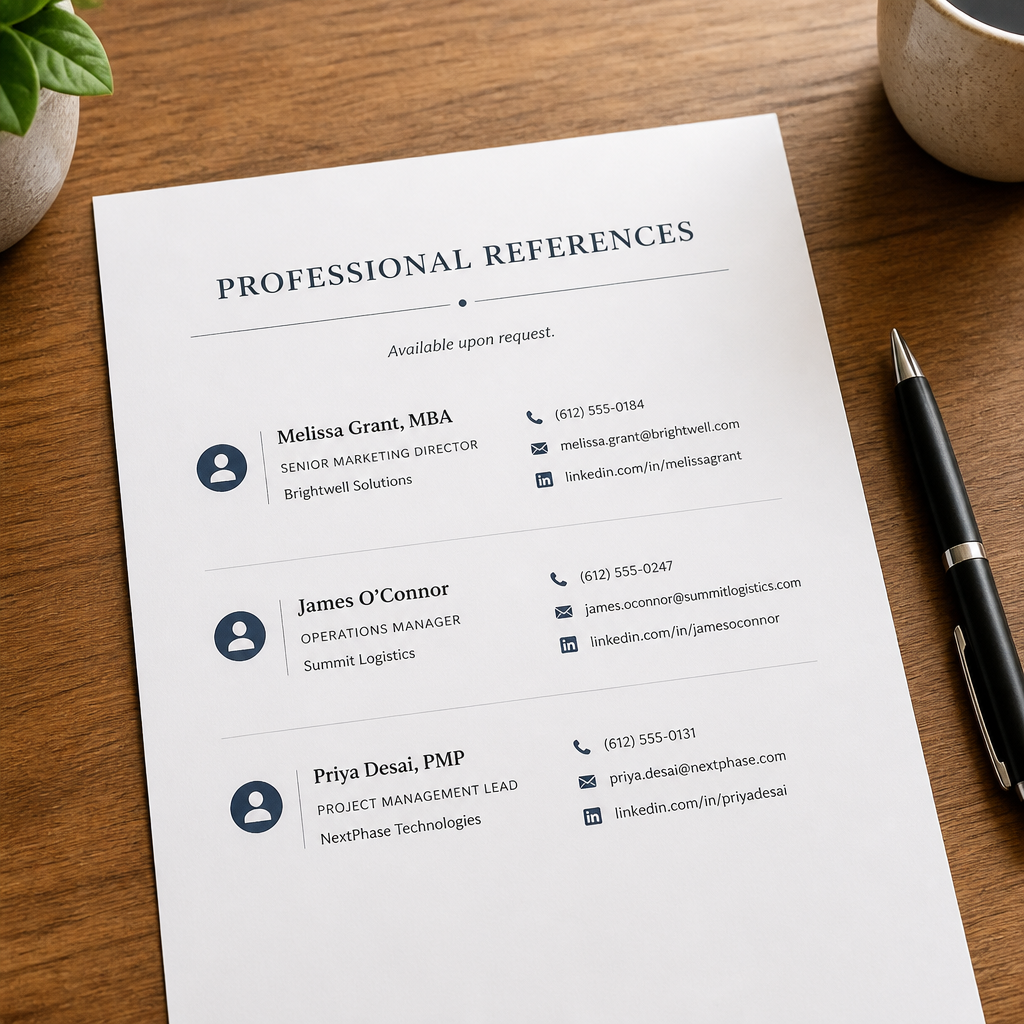
A clear, well-organized reference list makes it easy for an employer to follow up quickly.
How should you ask someone to be your reference, and is it better to ask by email, phone, or in person?
Ask directly and give the person an easy, honest way to say no. Something like, "I'm job searching and would really value your support as a reference - would you be comfortable speaking to my work if an employer reached out?" respects their time and gives them the option to decline gracefully if they're not the right fit or don't have the bandwidth.
Phone or in-person conversations tend to work best for the initial ask, since tone and warmth come through more easily and it gives the person a natural chance to ask questions. Email is a reasonable follow-up for sending details once someone has already agreed, but a cold email asking someone to be a reference out of the blue can feel impersonal, especially with people you haven't spoken to in a while.
What information should you provide when asking someone to be a reference, and should you send them your résumé and the job posting?
Once someone agrees, give them enough context to speak confidently and specifically. That includes an updated résumé so they can refresh their memory on your full work history, the job posting or a brief description of the role you're applying for, and a short reminder of specific projects or accomplishments you worked on together that might be relevant to the position.
Yes, sending the résumé and job posting is genuinely helpful, not excessive. It lets your reference tailor what they emphasize to what the employer is actually looking for, which makes their answers feel more relevant and thoughtful rather than generic.

A quick heads-up call before an employer reaches out keeps your reference prepared and confident.
How much notice should you give a reference before an employer contacts them, and should you ask permission every time you use someone?
Give your reference as much notice as possible, ideally as soon as you know an employer is likely to follow up - ideally at least a day or two before the expected contact, though even a same-day heads-up is far better than none. This lets them mentally prepare and makes sure they're not caught off guard by an unexpected call or email.
Yes, it's good practice to check in with your reference before each use, even if they've agreed in general to be a reference for your search. A quick message letting them know which company might be reaching out, and roughly when, keeps them prepared and shows respect for the fact that they're doing you a favour each time.
How can you help your reference prepare for an employer's call or email?
Beyond sending your résumé and the job posting, it helps to remind your reference of specific examples they might want to mention - a project you led, a problem you solved, a skill you developed while working together. A short conversation or message along the lines of "if it's helpful, feel free to mention the client project we worked on together" gives them something concrete to draw from, rather than leaving them to recall details from memory under time pressure.
What details should be included on a professional reference list, and when should you provide references during the hiring process?
A reference list should include each person's full name, current job title, company or organization, phone number and email, and a short note on your relationship to them, such as "Former Supervisor at [Company]" or "Colleague, [Project Name]." Keeping the format clean and consistent with the rest of your job search materials makes it easy for an employer to act on quickly.
References are typically provided later in the hiring process, most often after an interview when an employer explicitly asks for them, or sometimes as part of a final-stage application. Providing them too early, before an employer has expressed real interest, uses up your references' time and goodwill on opportunities that may not go anywhere.
Should references be included directly on your résumé, and is it necessary to write "References available upon request"?
No, references generally shouldn't be listed directly on a résumé. Résumé space is limited and best used to highlight your own skills and experience - references belong on a separate document, provided only when requested. Listing them upfront also means sharing your references' contact information more widely than necessary, before you even know if an employer is seriously interested.
The phrase "References available upon request" is no longer necessary either. It's widely understood in modern hiring that references will be provided when asked, so including the line just takes up space without adding useful information. It's fine to leave it off entirely.
What questions are employers likely to ask your references, and how can you find out if a former employer has a reference-checking policy?
Employers typically ask about your job title and dates of employment, your key responsibilities, your strengths and areas for growth, how you handled challenges or conflict, whether you'd be rehired, and how you worked with others on the team. Some employers also ask more specific, role-related questions depending on what they're evaluating for the position.
Many larger organizations have a formal policy of only confirming dates of employment and job title, often routed through HR rather than a direct supervisor, due to legal liability concerns. It's worth asking your former supervisor or HR department directly whether this applies, so you know in advance whether to lean more heavily on other references who can speak in more detail.
What should you do if your former supervisor is unavailable or unwilling to provide a reference, and how can you build references with limited or no Canadian work experience?
If a former supervisor is unavailable or hesitant, it's completely reasonable to use a different reference from the same job - a colleague, a client you worked with directly, or someone from HR who can confirm your role and contributions. The goal is finding someone who can speak credibly to your work, not necessarily the most senior person available.
For job seekers with limited work experience or no Canadian work experience, references can still be built from volunteer work, academic projects, internships, professional associations, or freelance and contract work. Instructors, program coordinators, and volunteer supervisors are all valid references and are often more willing to provide detailed, thoughtful feedback than people assume, since they're used to supporting people early in their careers.
What should you do if you're concerned that a reference may give negative or unhelpful feedback?
If there's real doubt about how someone might represent you, it's usually safer to leave them off your list entirely and choose someone who can speak positively and specifically about your work. There's little upside to including a reference you're unsure about, since one lukewarm or negative response can undo the strength of your other references.
If you're uncertain rather than sure, it can help to ask the person directly and honestly whether they'd feel comfortable providing a strong reference. Most people will either agree confidently or decline gracefully, and either answer gives you useful information before an employer ever gets involved.

A genuine thank-you goes a long way toward keeping a reference relationship strong for the future.
How should you thank someone after they provide a reference, and how can you maintain positive relationships with your references throughout your career?
A simple, genuine thank-you goes a long way - a short email, message, or handwritten note letting them know you appreciate the time they took, and ideally letting them know the outcome once you hear back, whether or not you got the job. People remember being kept in the loop, and it makes them far more willing to help again in the future.
Maintaining these relationships over the long run doesn't take much - an occasional check-in, a congratulations on their own career news, or simply staying connected on LinkedIn keeps the relationship warm without feeling transactional. References are a two-way relationship, and people are far more willing to speak enthusiastically on your behalf when the connection has been maintained genuinely, not just reactivated whenever you happen to need something.
Where can job seekers get support building a strong reference strategy and job search plan?
Figuring out who to ask, how to prepare them, and how to present references professionally is just one piece of a much bigger job search. Job Skills works directly with job seekers to build every part of that search, from résumé and interview preparation to reference strategy and connections with local employers. Whether you're just starting to build your professional network or refining a search that's already underway, support is available to help you move forward with confidence.
Your References Are Part of Your Story
References aren't a formality tacked onto the end of a job search - they're one of the most direct ways an employer gets to hear about your work from someone other than you. Choosing the right people, asking them thoughtfully, preparing them well, and staying in touch afterward all shape how strong that final impression turns out to be. A little care here goes a long way toward turning a good candidate into the one who gets the offer.
Looking for More Support With Your Job Search?
Job Skills helps job seekers build every part of a strong job search, from résumés and interviews to reference strategy and employer connections.
Explore Job Seeker Support