


Most HR professionals and people managers will tell you they have a pretty good read on their team. They know who’s motivated, who’s frustrated, and who’s quietly counting down to Friday. They catch the signals in one-on-ones, read the room in team meetings, and pick up on the informal conversations that happen in hallways and over lunch.
And they’re often right. But they’re rarely right about everything.
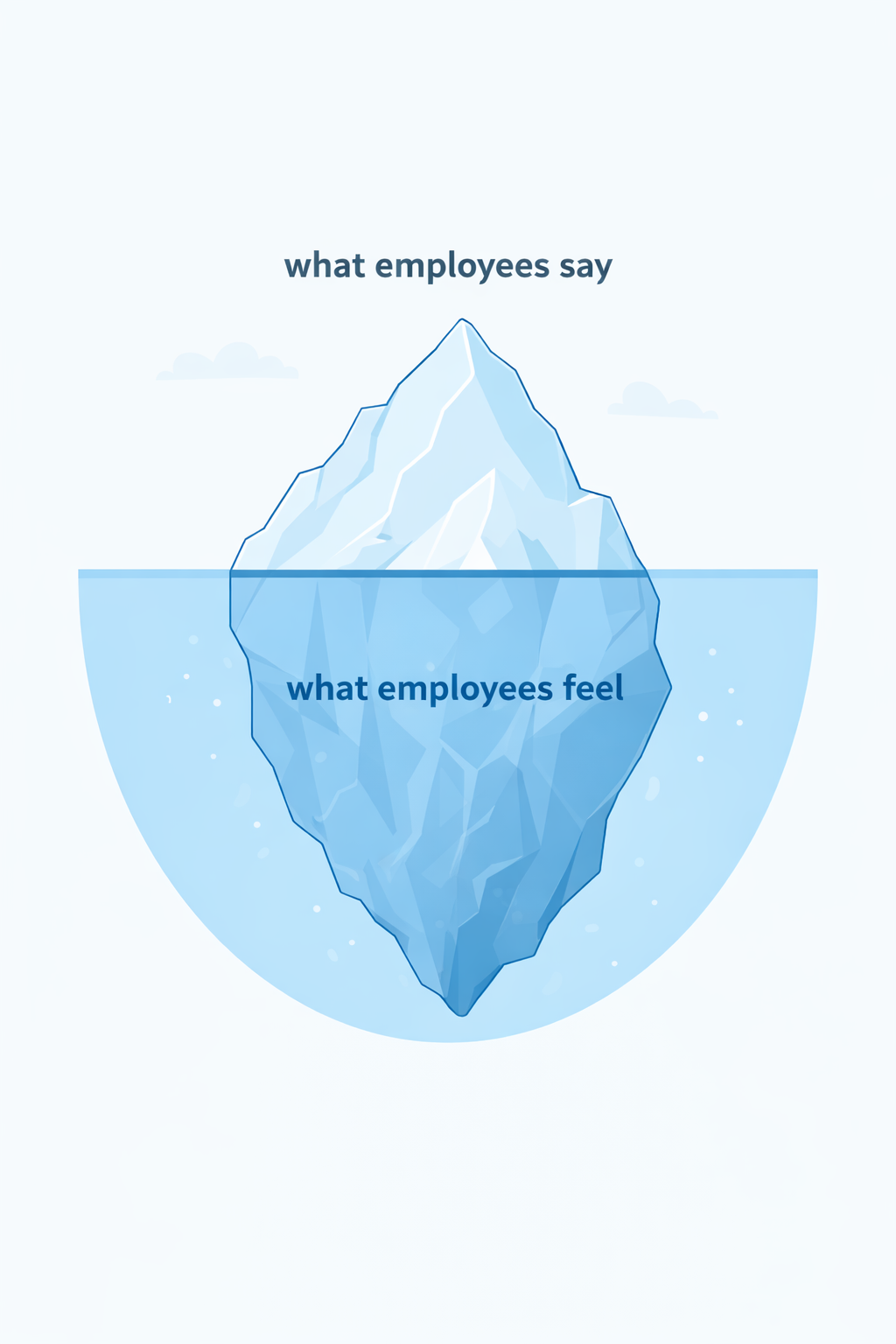
The gap between what managers observe and what employees actually feel is one of the most consistent findings in workplace research. It’s not a reflection of poor management. It’s a reflection of human nature. People filter what they share with their direct supervisors. They manage upward, even when they don’t mean to. And the things that matter most to them at work are frequently the things they’re least likely to say out loud.
That gap is where disengagement quietly takes root.
Engagement Isn’t Satisfaction
One of the most important distinctions in people management is the difference between employee satisfaction and employee engagement. They sound similar. They’re not.
A satisfied employee is content. They like their salary well enough, they don’t hate their commute, and they have no immediate plans to leave. Satisfaction is the absence of major complaints.
Engagement is something else entirely. An engaged employee is invested. They care about the work, the team, and the organisation’s success. They bring discretionary effort. They stay through hard stretches not because they have to, but because they want to.
Organisations with high engagement consistently outperform those without it. And organisations that mistake satisfaction for engagement are often blindsided when good people leave, performance stagnates, or culture quietly deteriorates.
The only reliable way to know where your team actually sits on that spectrum is to ask them. Directly, thoughtfully, and in a way that gives them genuine permission to be honest.
What Gets in the Way of Honest Feedback
Even organisations that genuinely want honest employee feedback often don’t get it. A few reasons tend to come up consistently.
Anonymous feedback channels that don’t feel genuinely anonymous. If a team has three people and the survey asks for your department and tenure, employees can do the math. If the feedback isn’t truly confidential, people default to safe answers.
Surveys that ask the wrong questions. A well-meaning pulse check that focuses on surface-level satisfaction metrics will miss the deeper drivers of engagement. Questions need to be designed to surface what actually influences commitment, performance, and retention.
Feedback that disappears into a void. Nothing disengages employees faster than being asked for their input and never seeing any evidence it was heard. When survey results aren’t communicated and action isn’t taken, the next survey gets answered with cynicism, not candour.
For HR professionals and people managers, the challenge isn’t just collecting feedback. It’s building a process that employees trust enough to engage with honestly, and that produces insights specific enough to act on.

The Case for an External Survey Partner
Many organisations attempt to run employee engagement surveys internally. It’s understandable. It seems more efficient, more economical, and more in keeping with a self-sufficient team.
But internal surveys carry a built-in credibility problem. Even when anonymity is promised, employees are often uncertain whether it’s truly guaranteed. The HR team is part of the organisation. The results will be seen by people they work with. That uncertainty is enough to change how people answer.
An external survey partner changes that dynamic. When a third party is administering the survey, collecting the responses, and synthesising the results, employees are more likely to answer candidly. And candid answers are the only answers worth having.
Beyond credibility, an experienced external partner brings something else: expertise in what to ask. Engagement is a complex, multi-dimensional concept. The questions that reliably predict retention, performance, and culture health are not always intuitive. A well-designed survey instrument is worth more than a dozen informal check-ins.
What to Look for in a Survey Partner
Not all employee engagement survey providers are built the same. For HR professionals evaluating options, a few things are worth looking for.
Customisation matters. Your organisation has a specific culture, context, and set of priorities. A survey that can be tailored to reflect that will generate more relevant and actionable insights than a generic off-the-shelf instrument.
Reporting should drive action, not just document sentiment. The output of a good engagement survey isn’t a data dump. It’s a clear picture of where things stand, what’s driving the results, and what decisions it should inform.
Accessibility and affordability for smaller organisations. Enterprise-grade engagement platforms are designed for enterprise-scale budgets. HR professionals at small and mid-sized organisations deserve equally rigorous tools at a price point that makes sense.
If you’re responsible for the people side of your organisation and you’re not currently running a structured employee engagement process, it’s worth asking what you might be missing. The insights are almost always surprising. And acting on them is almost always worth it.
Job Skills offers affordable, customised employee engagement surveys designed for small and mid-sized organisations across York Region and the GTA. With nearly 40 years in employment and workforce development, we bring real expertise to the process. Learn more about our Employee Engagement Survey service here.